Introduction
Professionals in the United States, United Kingdom, and Canada face intense workplace challenges—tight deadlines, financial pressure, rapid technology changes, and constant burnout.
In this demanding environment, productivity and mental well-being have become essential skills, not optional luxuries.
Surprisingly, some of the most powerful teachings on focus, discipline, emotional balance, and decision-making come from the Bhagavad Gita, an ancient scripture that remains more relevant today than ever.
Modern psychology, corporate training programs, wellness apps, and leadership coaches promote techniques that the Gita explained thousands of years ago.
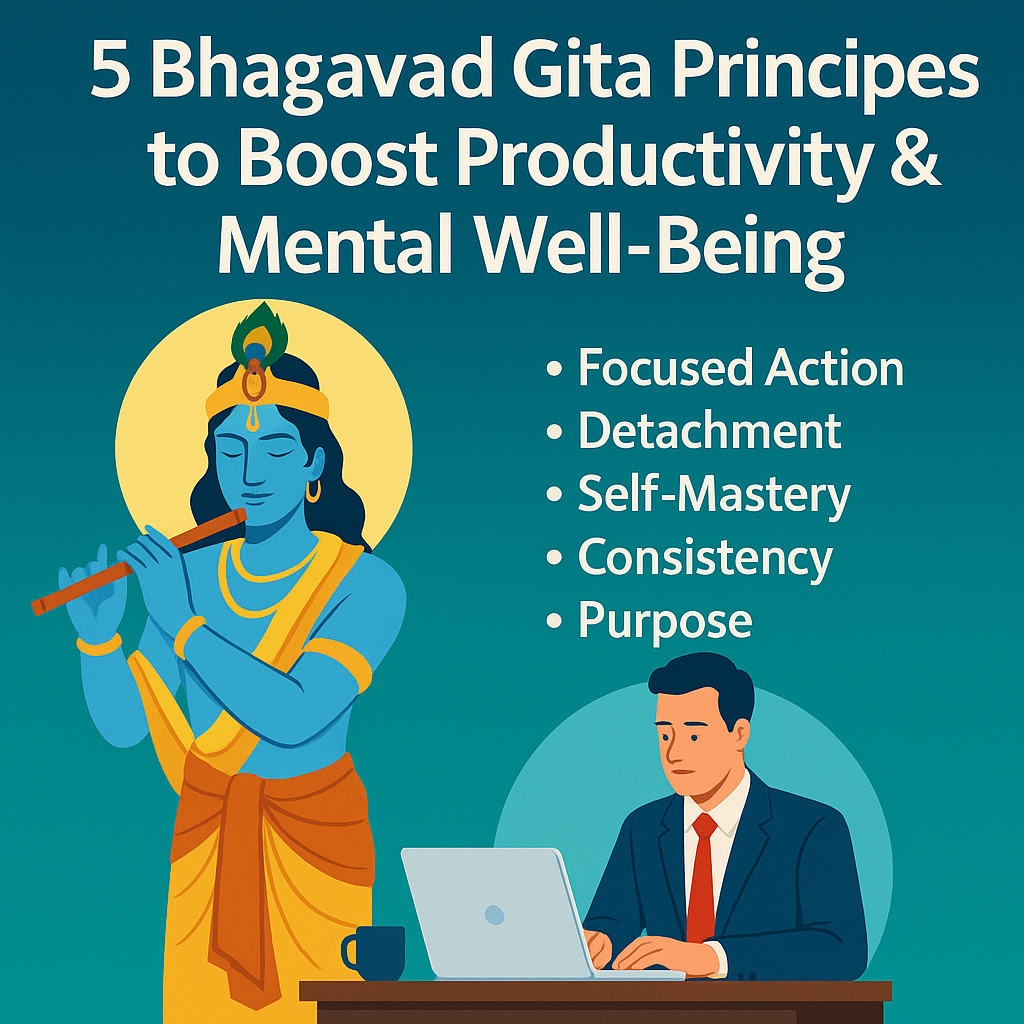
In this article, we break down five powerful Gita principles that can dramatically elevate your productivity, mental clarity, and emotional strength in today's fast-paced professional world.
⭐ 1. Principle of Focused Action: Eliminate Distractions
“When the mind is disciplined and focused, one becomes steady in purpose.”
— Bhagavad Gita, Chapter 6
The biggest productivity killers in the West are:
Multitasking
Constant notifications
Unclear priorities
Mental clutter
Krishna teaches that single-pointed focus is the path to excellence.
✔ Why this improves productivity
Science confirms that multitasking reduces efficiency by up to 40%.
Focusing on one task at a time increases output and lowers stress.
✔ How to apply
Use a “one-hour deep focus” block daily
Keep your phone in another room
Turn off all notifications during work
Create a priority list each morning
This instantly boosts both productivity and mental calmness.
⭐ 2. Principle of Detachment: Work Without Emotional Exhaustion
“You have the right to your work, but not the outcome.”
— Gita 2.47
Burnout happens when professionals attach their identity to:
Results
Deadlines
Promotions
Approval from others
This emotional attachment increases anxiety.
Krishna’s solution?
👉 Perform your duty with full commitment
👉 Release emotional dependency on the outcome
✔ Modern psychology agrees
This is similar to Cognitive Behavioral Therapy (CBT) which reduces stress by reframing expectations.
✔ How professionals can use this
Focus on effort, not perfection
Celebrate progress, not just final results
Don’t let failures damage your self-worth
Detachment leads to long-term emotional stability and higher productivity.
⭐ 3. Principle of Self-Mastery: Control the Mind and Emotions
“The mind can be one’s best friend or greatest enemy.”
— Gita 6.5
Professionals in corporate environments often struggle with:
Overthinking
Stress
Emotional reactions
Impulse decisions
Lack of patience
The Gita teaches self-mastery, which means becoming aware of your inner state.
✔ How this improves performance
When your mind is stable, your decisions are sharper, communication becomes clearer, and work quality improves.
✔ Daily practice
10-minute breathing meditation
Emotional journaling
Replace negative self-talk with positive statements
Pause before responding in stressful situations
Self-mastery is the foundation of leadership.
⭐ 4. Principle of Consistency: Discipline Over Motivation
“Through steady practice, one becomes grounded in knowledge and strength.”
— Chapter 6
The biggest success factor in the professional world is not motivation—it’s discipline.
Motivation is temporary; discipline is permanent.
✔ Why the Gita emphasizes discipline
Krishna explains that consistent effort builds inner power.
✔ How professionals can apply this
Set a small daily routine (10 minutes meditation, 10 minutes reading, etc.)
Start tasks even without motivation
Track your habits
Avoid procrastination by breaking tasks into small steps
Discipline produces predictable results, which lead to job success and personal peace.
⭐ 5. Principle of Purpose: Align Work With a Higher Meaning
Many people in USA, UK, and Canada report:
Feeling disconnected from their job
Lack of deeper meaning
Emotional dissatisfaction
Mental fatigue
Krishna guides Arjuna to find his Dharma—his inner purpose.
✔ Why this reduces stress
When your work aligns with your values, you experience:
Natural motivation
Lower anxiety
Higher fulfilment
Better teamwork
Stronger resilience
✔ Reflection exercise
Ask yourself:
What activities make me feel alive?
What skills come naturally to me?
How does my work contribute to others?
Finding clarity brings peace and long-term satisfaction.
⭐ Conclusion
The Bhagavad Gita is far more than a spiritual book—it is a leadership and productivity manual for modern professionals.
By applying these five timeless principles:
✔ Focused action
✔ Detachment
✔ Self-mastery
✔ Consistency
✔ Purpose-driven living
you can boost productivity, reduce stress, and build a mentally resilient life—no matter where you live or what career path you follow.
In a world full of pressure and distractions, the Gita offers a calm, powerful reminder:
Master yourself, and you will master your life.